Whole-Home Backup Battery Quote Coming? Size It First in 6 Steps
Size it from the circuits you must run, their combined draw and the hours they must last, not from the size of the house. One battery will not run an entire home, and the 13.5 kWh median battery installed with solar in 2025 takes three 5.12 kWh blocks.
Whole-home battery backup takes more than one battery. Three things decide how many you need: the circuits you want running, how much power they draw at once and how long they must run. That number decides the bill. Know it before an installer quotes you.
Palmetto’s homeowner guide says it outright: “One battery will not run an entire home.” Central air conditioning (AC), electric dryers and electric ovens pull a lot of power fast. Palmetto also says whole-home backup “will require more than one battery (and more money).” So your system’s size comes from the list of circuits you want running in an outage, not from the size of the house.
One battery won’t run an entire home because heavy loads draw too fast
A battery has two limits. Capacity, in kilowatt-hours (kWh), is how long it lasts. Continuous output, in kW, is how much power it can deliver at one time. A dryer, an oven and central AC hit the second limit, and they often run at once.
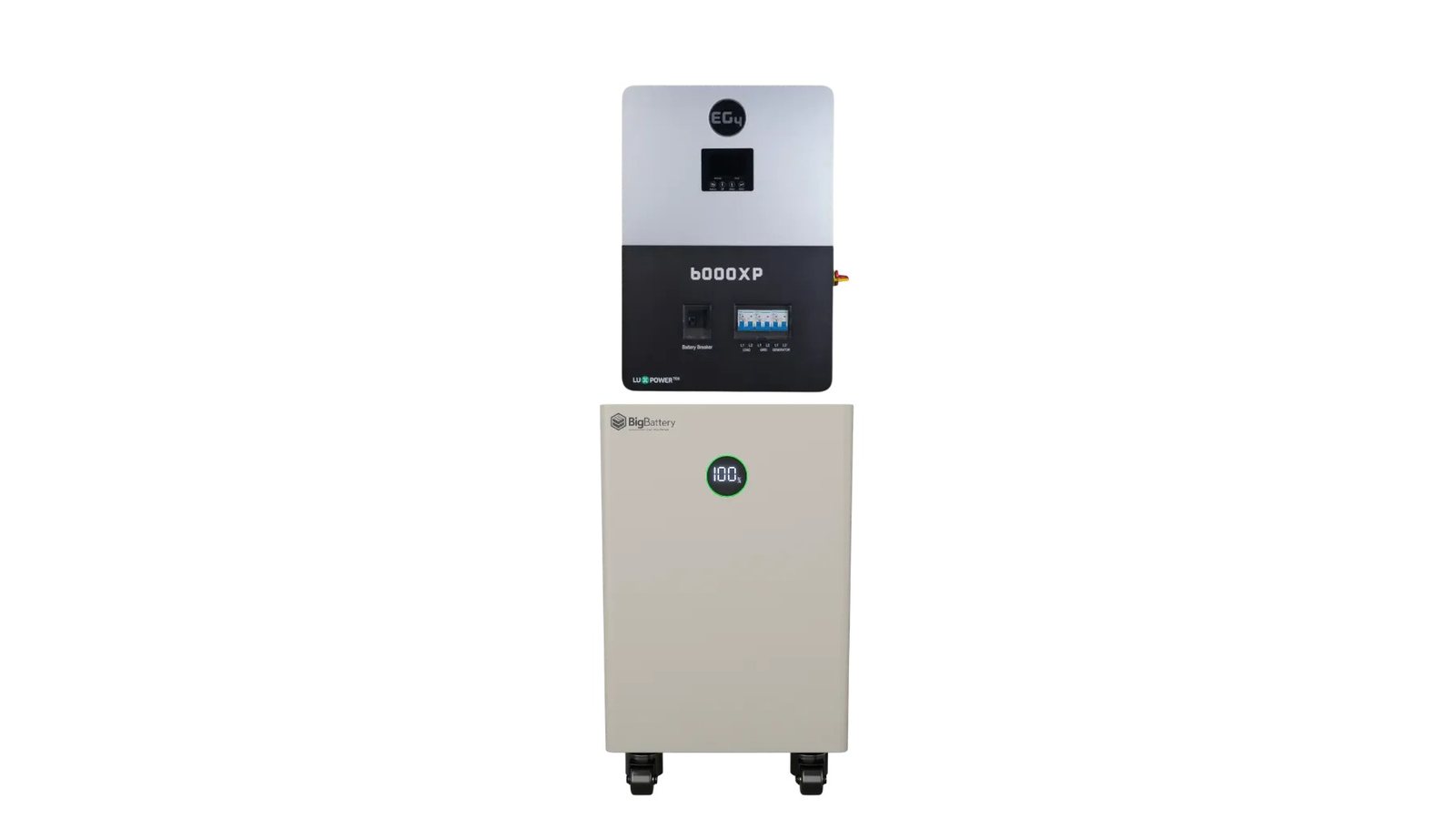
BigBattery lists its NEXUS 2 battery at 7.6 kW continuous discharge. It pairs it with an EG4 6000XP inverter rated at 6 kW split-phase 120/240V output (BigBattery’s solar page). The system can deliver only the lower number, 6 kW, however much energy is stored behind it.
That doesn’t mean every home with an electric oven needs more than one battery. Palmetto’s point is about running the entire home. If one of those loads is on your must-run list, ask the installer whether the system’s continuous output can cover it, and what they would change if it can’t.
A backup battery powers only the circuits wired to it
Per Palmetto, a battery runs only the circuits connected to it, and your installer helps you choose them. The usual picks are the refrigerator, the lights and the internet router.
Start with Ready.gov’s advice: before an outage, take an inventory of the items you need that run on electricity. That list becomes your circuit list.
Next, decide how many hours the battery must carry that list in one outage. For scale, U.S. Energy Information Administration (EIA) figures cited by Palmetto put the average U.S. customer’s total time without power in 2024 at about 11 hours. South Carolina’s was nearly 53 hours. Those are yearly totals, not the length of one outage.
Who should skip whole-home backup: if your list stops at those usual picks, skip it. Palmetto’s runtime table gives a small 5 kWh battery, in a home without a heat pump, 7+ days on sunny days and 18 hours on cloudy ones. Those estimates assume solar panels recharging the battery and a set load: a refrigerator, WiFi, phone chargers, a television, a microwave, lighting and two laptops.
Without solar, they don’t apply to you, so ask your installer to estimate runtime for your own list. Price an essential-circuits system with our home battery backup sizing and price-per-watt-hour guide. For the shortest lists, a portable power station from our roundup may be enough.
Stacking 5.12 kWh blocks: the 13.5 kWh median takes three
BigBattery’s ETHOS system is built from modular, stackable 5.12 kWh batteries that you add as your needs grow (BigBattery). Divide each battery size below by 5.12 and round up to get the number of blocks:
| Battery size | Where the figure comes from | 5.12 kWh blocks | Stacked capacity | Runtime figure |
|---|---|---|---|---|
| Small, 5 kWh | Palmetto runtime table | 5 ÷ 5.12 = 0.98 → 1 | 5.12 kWh | With solar, no heat pump: 7+ days sunny, 18 hours cloudy |
| Large, 10+ kWh | Palmetto runtime table | 10 ÷ 5.12 = 1.95 → 2 | 10.24 kWh | With solar: 7+ days sunny; cloudy 49 hours without a heat pump, 19 hours with one |
| 2025 median with solar, 13.5 kWh | Berkeley Lab, cited by Palmetto | 13.5 ÷ 5.12 = 2.64 → 3 | 15.36 kWh | Not given |
| NEXUS 2 + EG4 6000XP | BigBattery | Sold as one bundle | 16.1 kWh | 16.1 kWh ÷ 6 kW = 2.7 hours at full output |
BigBattery lists the ETHOS Off-Grid System “starting at $4,879.99.” Its page doesn’t say how many 5.12 kWh blocks that includes or give a price per block, so you can’t work out ETHOS’s cost per kWh from it.
The off-grid NEXUS 2 + EG4 6000XP bundle is listed starting at $4,744.99 for 16.1 kWh. That works out to $4,744.99 ÷ 16.1 kWh = $294.72 per kWh, or about $0.29 per watt-hour (BigBattery, October 2026). It’s a “starting at” price, so ask what that setup includes and whether installation is part of it.
Enphase’s IQ Batteries have an integrated load controller. It turns power-hungry appliances on and off from the Enphase App to save your charge during an outage, automatically or by hand (Enphase). BigBattery lists a 12-year warranty. Enphase lists a 15-year limited warranty.
Cost is the catch. Emporia Energy names the upfront purchase and installation cost as one of the main drawbacks of home battery backup, and every extra block adds to that bill.
So let your circuit list set the size, not the median. The 13.5 kWh figure is what the typical battery installed with solar in 2025 held, not a target for your home. Pay only for what your must-run circuits, their combined draw and your hours call for.
Wired home batteries fall under UL 9540, portable packs under UL 2743
UL 2743 sorts portable power packs into three use categories: outdoor, temporary outdoor and indoor use only (UL Standards & Engagement). The same page says packs permanently connected to a home’s wiring fall under UL 9540 instead. For a portable unit, check which of the three categories it is listed for. For a wired home battery, ask your installer about UL 9540.
Enphase rates its IQ Batteries NEMA 3R, a weather rating it says covers rain, sleet, snow and ice. Where a battery can be mounted at your house is for your installer and local code to decide.
The federal battery credit ended for systems placed in service after 2025
The IRS says battery storage needed a capacity of at least 3 kWh to count as qualified clean energy property for the residential clean energy credit. Every size in the table above meets that. But the same page says the credit is not available for any property placed in service after December 31, 2025. For an install in 2026, the 3 kWh rule no longer matters.
Leave the credit out of the price you compare. If your system went in earlier, check the IRS page for the rules for that year.
Checklist: size a whole-home backup in six steps before you call an installer
- Write the outage list. As Ready.gov advises, list every item you need that runs on electricity. Then mark the ones that must keep running, and for how many hours.
- Turn items into circuits. A battery runs only the circuits wired to it (Palmetto). Bring your panel’s circuit labels to the first call, with the must-run circuits marked.
- Decide on the heavy loads. For central AC, a dryer or an electric oven, ask every installer two questions: can the continuous output cover it, and is load control included? Enphase’s controller turns power-hungry appliances on and off during an outage (Enphase).
- Convert kWh to blocks. Divide your target by 5.12 and round up (BigBattery). Then ask for the continuous kW: a 6 kW inverter limits a 7.6 kW battery to 6 kW.
- Divide every quote by its kWh. The NEXUS 2 per-kWh figure above is the “starting at” price of an off-grid kit and may not include installation, so it isn’t a like-for-like match for an installed quote. Ask what each quote includes and how long its warranty runs.
- Settle location, listing and tax date. Ask whether the battery will go outdoors (Enphase’s IQ Batteries are NEMA 3R). Confirm the wired system is UL 9540 listed. Don’t count the residential clean energy credit for anything placed in service after December 31, 2025 (IRS).
FAQ
Can I start small and add batteries later? Yes. Enphase says you can add more batteries as your energy needs grow (Enphase). BigBattery lists up to 60 kWh of stackable storage (BigBattery).
What does Enphase’s Storm Guard do? It’s a feature in the Enphase App that prepares your home for a storm. When the National Weather Service detects a storm, it fully charges your batteries (Enphase).
Is UL 9540A the same as UL 9540? No. Enphase lists UL 9540A, a test method for how a battery fire spreads. UL 9540 is the safety standard for the storage system itself, and it’s the one the UL 2743 page names for batteries wired into a home.
More capacity and price math is on our batteries and capacity page.
Sources
- https://palmetto.com/solar/homeowners-guide-home-battery-backup
- https://bigbattery.com/solar/
- https://enphase.com/homeowners/home-solar-batteries
- https://www.irs.gov/credits-deductions/residential-clean-energy-credit
- https://www.shopulstandards.com/ProductDetail.aspx?productId=UL2743
- https://www.ready.gov/power-outages
- https://www.emporiaenergy.com/blog/pros-and-cons-of-investing-in-a-home-battery-backup-system-in-the-united-states/